
Health Insurance After the Death of a Spouse: COBRA Timelines, the Medicare Part B Trap, and What to Do First

The death of a spouse forces some of the most time-sensitive insurance decisions a person will ever face. They arrive while the survivor is grieving, settling an estate, and running a household alone. COBRA, Medicare, and the marketplace each run on fixed clocks that don’t pause for hard circumstances. Missing one can mean a gap in coverage, or a Medicare penalty that lasts for life.
What to Do First
Within the first few weeks, four things matter most:
Figure out what kind of coverage you had. Was it through your spouse’s current job, a retiree plan, or something else? The answer decides which rules apply to you.
Watch for the COBRA election notice from the plan, and don’t let the election deadline pass while you compare options.
If you’re 65 or older, call Social Security about Medicare Part B now. Don’t wait until COBRA ends.
If you’re under 65, compare marketplace coverage within 60 days of losing the plan.
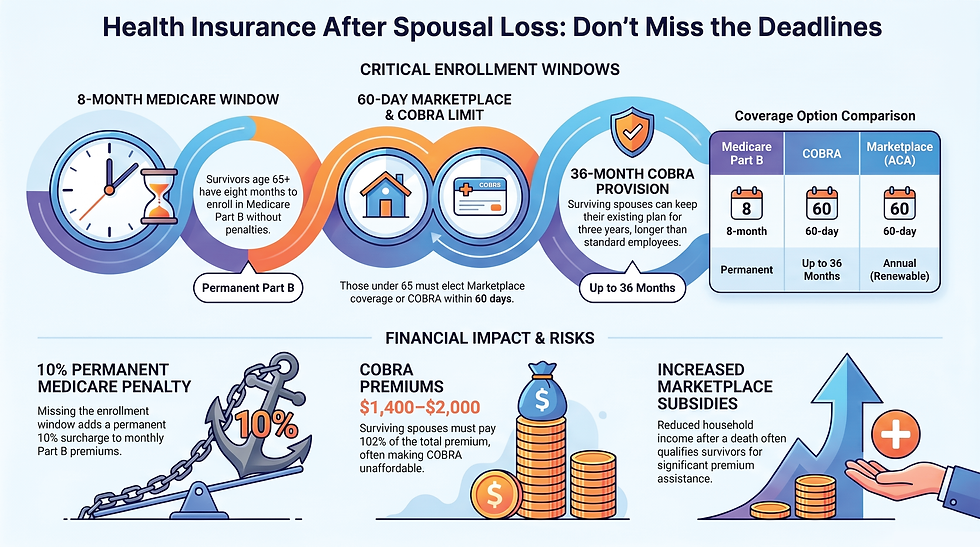
COBRA: Up to 36 Months for Surviving Spouses
When a covered employee dies, the surviving spouse and dependent children on the plan can keep that coverage through COBRA for up to 36 months. That’s longer than the 18 months available after a job loss.
The timeline is set by federal rules:
The employer notifies the plan. The employer must tell the plan about the death within 30 days. The surviving spouse doesn’t have to send this notice.
The plan sends an election notice within 14 days of hearing from the employer.
You get at least 60 days to elect, counted from the later of the date you receive the notice or the date coverage ends.
The first payment isn’t due at election. You get at least 45 days after electing to make it.
Those windows give you time to compare options while keeping COBRA available as a safety net. Before you rely on it, confirm with the plan administrator exactly when coverage would start.
COBRA keeps the same plan, network, and benefits. The catch is cost. The plan can charge up to 102% of the full premium, covering both the employer’s share and the employee’s share. Based on KFF’s 2025 average premiums, that’s about $2,294 a month for family coverage and $793 a month for single coverage. After a sudden drop in household income, that price often rules COBRA out as a long-term option.
The Medicare Part B Trap
This is where surviving spouses 65 and older get hurt. If you were covered on your spouse’s plan through their current job, you may have put off Medicare Part B. That’s allowed while the coverage is based on current employment. When your spouse dies, that coverage ends and a clock starts.
You get an 8-month Special Enrollment Period to sign up for Part B. It begins the month after the job or the job-based coverage ends, whichever comes first. A death ends the job immediately, so the clock starts right away.
Two rules turn this into a trap:
COBRA doesn’t stop the clock. COBRA isn’t coverage based on current employment, so electing it doesn’t extend your Special Enrollment Period. If you sit on COBRA and wait for it to run out, you can miss the window entirely.
Retiree coverage doesn’t create a window at all. If your spouse was already retired and you were on a retiree plan, you don’t get a Special Enrollment Period when it ends. In that case, you should already have enrolled in Part B when you were first eligible.
Missing the window costs money every month. The Part B late penalty adds 10% of the base premium for each full 12-month period you could have had Part B but didn’t, and it usually lasts for as long as you have Medicare. The base Part B premium in 2026 is $202.90. A two-year delay adds about $40.58 a month at today’s rate, or nearly $9,750 over 20 years, before premium increases.
There’s another reason not to rely on COBRA alone. Once you’re eligible for Medicare, Medicare usually pays first and COBRA pays second. Some plans pay as if Medicare were primary even when you never enrolled, which can leave you with large unpaid bills. And if you enroll in Medicare after electing COBRA, the plan may end your COBRA coverage.
Marketplace Coverage for Surviving Spouses Under 65
Losing job-based coverage lets you enroll in a marketplace plan within 60 days. Being offered COBRA doesn’t take that option away. You can compare the two and pick the better one. You can also leave COBRA for a marketplace plan if you’re still within 60 days of losing the original coverage. After that, dropping COBRA early doesn’t qualify you to switch until the next open enrollment.
Income often falls after a spouse’s death, which can unlock real savings. Marketplace help is based on expected household income for the coverage year. That includes Social Security survivor benefits, counted in full whether or not they’re taxed.
Take a single surviving spouse with $35,000 in expected 2026 income. That’s about 224% of the federal poverty level. At that level, the expected contribution toward a benchmark Silver plan is roughly 7.5% of income, or about $218 a month. As part of a two-income household, the same person may have earned too much to get any help. The limit for a single person in 2026 is 400% of the poverty level, or $62,600.
A broker can compare COBRA, marketplace plans, and Medicare side by side, based on the household’s actual finances after the loss.
Sources
U.S. Department of Labor. “An Employee’s Guide to Health Benefits Under COBRA.” September 2022. https://www.dol.gov/sites/dolgov/files/ebsa/about-ebsa/our-activities/resource-center/publications/an-employees-guide-health-benefits-under-cobra-2022.pdf
KFF. “2025 Employer Health Benefits Survey.” October 22, 2025. https://www.kff.org/health-costs/2025-employer-health-benefits-survey/
Social Security Administration. “Special Enrollment Period (SEP).” https://www.ssa.gov/help/iClaim_medSEP.html
Medicare Rights Center, Medicare Interactive. “Medicare Part B late enrollment penalties.” https://www.medicareinteractive.org/understanding-medicare/health-coverage-options/original-medicare-enrollment/medicare-part-b-late-enrollment-penalties
HealthCare.gov. “COBRA coverage when you’re unemployed.” https://www.healthcare.gov/unemployed/cobra-coverage/
HealthCare.gov. “What’s included as income.” https://www.healthcare.gov/income-and-household-information/income/
HealthCare.gov. “Federal poverty level (FPL).” https://www.healthcare.gov/glossary/federal-poverty-level-fpl/
Internal Revenue Service. Revenue Procedure 2025-25. https://www.irs.gov/pub/irs-drop/rp-25-25.pdf


Comments