
Pre-Medicare Coverage: Health Insurance Options for Ages 62–64
- Compass Health Consultants®

- May 28
- 4 min read
If you are between 62 and 64 and no longer have employer health coverage, you are in one of the most expensive insurance situations in the American healthcare system. You are too young for Medicare and too old for cheap individual premiums. But you have real options — and with the right guidance, you can find solid coverage at a manageable cost until Medicare begins at 65.
Why Is Health Insurance So Expensive Before Medicare?
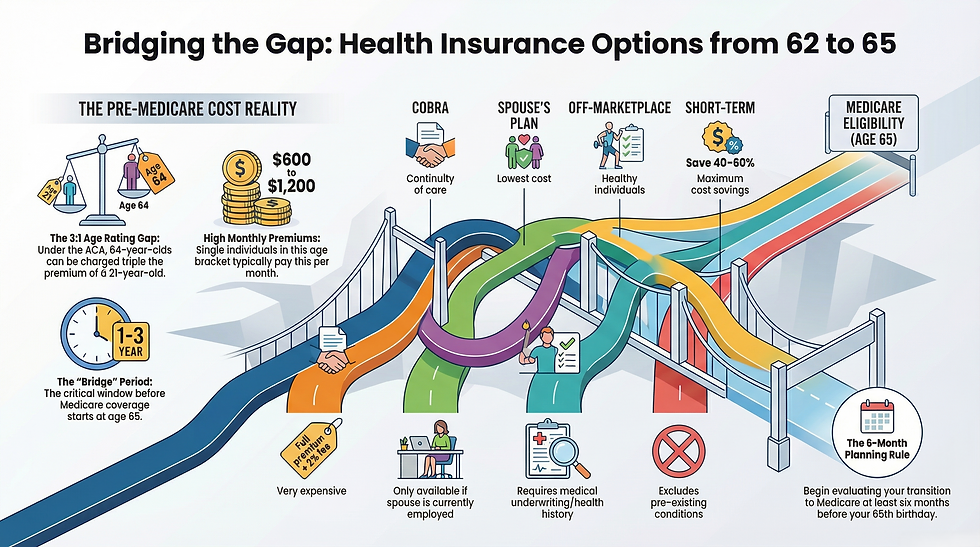
Insurers can charge older adults significantly more than younger ones. Under the ACA, the ratio is capped at 3:1 — a 64-year-old can be charged up to three times what a 21-year-old pays for the same plan. At 62–64, you are in the highest pricing tier for individual health insurance, and you are statistically more likely to use healthcare services. This combination drives premiums that can reach $600–$1,200 per month or more for a single person, depending on state and plan type.
What Are Your Health Insurance Options Before Medicare?
Option 1: COBRA Continuation Coverage
If you left a job with employer health coverage, COBRA lets you continue that exact plan for up to 18 months (or up to 36 months in some circumstances). The coverage is identical to what you had at work. The catch: you pay the full premium — both the employee and employer share — plus a 2% administrative fee. For many people, this is shockingly expensive: a plan that cost $200/month out of your paycheck may cost $1,400+/month under COBRA. COBRA works well as a short bridge while you shop for alternatives, but it is rarely the most cost-effective long-term solution.
Option 2: Individual and Family Plans (Off-Marketplace)
Off-marketplace individual health plans from private carriers can offer competitive coverage without going through the ACA exchange. These plans — often called 'medically underwritten' plans — may be priced based on your health history. If you are in good health, you may qualify for significantly lower premiums than marketplace rates. A licensed independent broker is the most efficient way to shop these plans because they have access to multiple carriers and can compare options you cannot find on HealthCare.gov.
Option 3: Short-Term Health Insurance
Short-term health insurance provides coverage for a defined period — typically 1 to 3 years depending on state regulations. These plans are not subject to ACA rules, which means they can be priced based on health status and often have significantly lower premiums. They also typically exclude pre-existing conditions, have lower benefit limits, and do not count as minimum essential coverage. Short-term plans are best suited for healthy people who need a temporary bridge at a lower cost.
Option 4: Spouse's Employer Plan
If your spouse is still working and has employer-sponsored coverage, you may be able to join their plan as a dependent. This is often the most cost-effective option available. Losing your own coverage is typically a qualifying life event that triggers a Special Enrollment Period for your spouse's plan, even outside open enrollment.
Pre-Medicare Coverage Options: Comparison
Best for Continuity: COBRA + Off-Marketplace
• COBRA: Exact same plan and network — no disruption to care
• Off-marketplace: Can be competitive if you are healthy
• Both count as minimum essential coverage
• Covers pre-existing conditions
• Works well as a bridge to Medicare at 65
Best for Cost Savings: Short-Term Plans
• Lower monthly premium — often 40–60% less than ACA plans
• No underwriting for minor health conditions in some states
• Renewable for up to 3 years in many states
• Simple application process — fast approval
• Suitable as a bridge for healthy individuals
How to Choose the Right Bridge Plan
The right pre-Medicare plan depends on three factors: your health status, your budget, and how many years you have until Medicare. If you have ongoing prescriptions or managed health conditions, an off-marketplace comprehensive plan or ACA plan will provide more reliable coverage. If you are in excellent health and have 1–2 years until Medicare, a short-term plan may save you $5,000–$10,000 in premiums with acceptable risk. An independent broker who specializes in this age group can model your options and help you avoid gaps or penalties.
Frequently Asked Questions
Q: Can I retire at 62 and still get health insurance?
Yes. You can use COBRA, purchase an individual plan on or off the marketplace, join a spouse's employer plan, or use a short-term plan as a bridge to Medicare at 65.
Q: How much does health insurance cost at age 63?
Costs vary significantly by state, plan type, and health status. A 63-year-old might pay $500–$1,200+ per month for an individual plan. Off-marketplace plans for healthy individuals can be more affordable.
Q: Does COBRA coverage affect Medicare enrollment?
COBRA is not considered active employer coverage for Medicare enrollment purposes. You cannot use COBRA as justification to delay Medicare without penalty.
Q: What is the best health insurance for early retirees?
There is no single best answer. A licensed broker can compare COBRA, off-marketplace individual plans, short-term coverage, and spousal plans based on your specific health needs and budget.
Key Takeaways
• Ages 62–64 face the highest individual health insurance premiums before Medicare eligibility.
• COBRA provides continuity but is often expensive — shop alternatives quickly.
• Off-marketplace individual plans can offer better pricing for healthy individuals.
• Short-term plans offer lower premiums but exclude pre-existing conditions.
• Start planning your coverage transition at least 6 months before Medicare begins at 65.
Sources & References
• KFF. How Costs in the ACA Marketplace Vary by Age and Income. kff.org
• Department of Labor. COBRA Continuation Coverage. dol.gov
• Medicare.gov. Medicare & You 2026 Handbook. medicare.gov


Comments