
Turning 26 and Aging Off a Parent's Plan: The 60-Day Window, What to Compare

Aging off your parents' health insurance plan? You get 60 days. That's the window after losing coverage to enroll somewhere else, and it doesn't pause because you're moving, starting a new job in three weeks, or just haven't gotten around to it. Miss it, and you're uninsured until the next open enrollment period, which could be months away.
The uninsured rate among adults 19 to 25 is higher than any other age group under 65. That statistic has a cause, and the 60-day window is a big part of it.
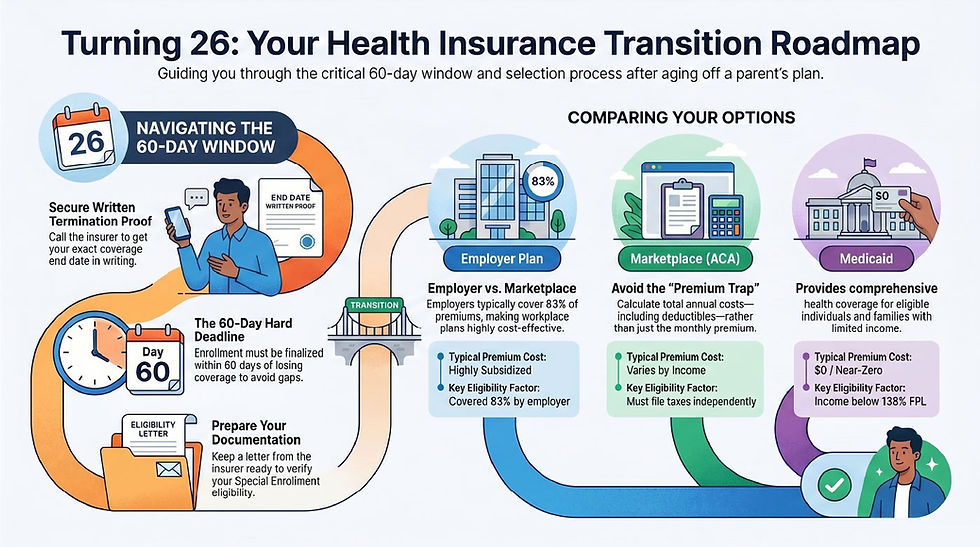
Find Out Exactly When Your Coverage Ends
Not every plan drops dependents on the 26th birthday. Some run coverage through the end of the birthday month. Some employer plans continue it through the end of the plan year. The difference could be weeks, and that's weeks when you don't need to have replacement coverage lined up yet.
Call the insurance company, not HR, not the website, and ask for the termination date in writing. That date starts your 60-day clock. You'll also need it as documentation when you apply for marketplace coverage, so keep it.
What the 60 Days Actually Requires
Losing coverage on a parent's plan qualifies as a loss of minimum essential coverage, which opens a Special Enrollment Period for ACA marketplace plans. The clock starts on the date coverage ends, not the date you find out about it. Day 61 is too late, and the marketplace will reject the application.
When you apply, the marketplace will ask for documentation. A letter from the insurer or your parent's employer stating the termination date is the standard form. Have it ready before you start the application; some systems allow self-attestation initially but require the document to finalize enrollment.
Employer Plan vs. Marketplace: Run the Actual Numbers
If your employer offers coverage, that's the first thing to look at. Employers cover about 83% of the single-coverage premium on average, per KFF's 2025 survey. Even a mediocre employer plan is hard to beat when the employer is paying most of it.
If there's no employer plan, or if your income is low enough to qualify for subsidies, the marketplace can be genuinely inexpensive. Under 150% of the federal poverty level (about $22,500 for a single adult in 2026) benchmark Silver plans are available for zero or near-zero premium. Between 150% and 400% FPL, subsidies taper but remain meaningful. One thing to know: if you're still being claimed as a dependent on your parents' tax return, you can't claim a premium tax credit. You'd need to file independently to access subsidies.
Medicaid is worth checking first if your income is below 138% FPL and your state expanded Medicaid. No premium, minimal cost-sharing, open year-round.
The Mistakes That Cause Problems Later
Choosing a plan by premium alone is the most common one. A $0-premium plan with a $7,000 deductible works fine if you're healthy and don't use healthcare. If you take a prescription, see a specialist, or end up in urgent care twice in a year, the total cost picture looks very different. Before picking a metal tier, add up the annual premium plus a realistic estimate of what you'd pay out-of-pocket based on how you actually use healthcare.
Dental and vision are separate. Most health plans don't cover routine dental or vision at all. If you've had pediatric dental through a parent's plan, that doesn't follow you. Budget for those costs separately or shop for standalone coverage.
And don't wait. Every day the window is open is a day closer to it closing. Marketplace applications take processing time, and coverage typically starts on the first of the month following enrollment — which means timing matters for avoiding a gap.
A licensed broker can compare your employer option, marketplace subsidies, and Medicaid eligibility side by side at no cost to you — the premium is the same whether you enroll through an agent or directly. Compass Health Consultants® works with clients nationally. Visit chcquotes.com.


Comments